The reason a perimenopause supplement comes as a drink is almost always arithmetic. A capsule holds roughly 500 mg of powder. Several of the ingredients with the best evidence are dosed in grams. The dose does not fit, so the format changes — or the dose quietly does.
The arithmetic
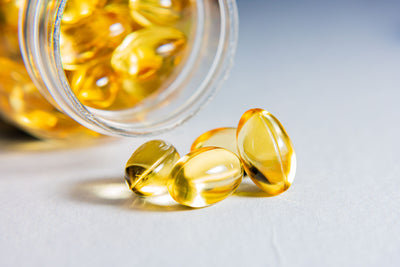
Glycine is the clearest example. The sleep-onset research uses 3 g before bed. At about 500 mg per capsule that is six capsules for one ingredient, before magnesium, before theanine, before anything else. A formula built around studied doses of that kind runs to several grams a serving, and nobody takes fifteen capsules at bedtime.
So a product has two options: change the format, or reduce the dose to something that fits the format. The second is far more common, and it is invisible unless the label prints the amounts.
Gummies are the extreme case. A gummy carries a few hundred milligrams of active at most; most of its mass is sugar and pectin. They are pleasant and they are convenient, and for ingredients dosed in grams they are structurally incapable of carrying a meaningful amount.
What a powder does and does not buy you
What it buys is room. Doses that appear in the literature, in a form you can actually take daily.
What it does not buy is a dramatic absorption advantage, whatever the marketing says. A dissolved powder does not need to disintegrate before absorption begins, so it tends to be somewhat faster — but for most ingredients the difference in how much ultimately gets absorbed is modest. Anyone promising a large multiple is overselling it.
The real trade-offs
A drink is not automatically better. It is better for some things and worse for others, and the honest list is short:
- Taste has to be solved. Grams of amino acids taste of something. Sweeteners and flavours are what make a clinical dose drinkable — so it is worth checking what they are.
- It needs water and about ten seconds. Less convenient than a capsule, more convenient than six capsules.
- Travel is harder. A jar and a scoop are not a blister pack.
- Added sugar varies enormously between products in this category. Check.
What to check on a powder label
- Dose per serving, and what a serving is. Sometimes a serving is two scoops. The front of the jar quotes the serving; the scoop is what you actually take.
- Every active printed with its amount. Same rule as everywhere: a proprietary blend means the doses are below anything meaningful.
- Total grams of active per serving against the studied doses for the ingredients named. This is the number that tells you whether the format is doing real work or is just a format.
- Sweeteners and added sugar. A daily product is a daily exposure.
- Whether it dissolves cold. Practical, and it decides whether you actually take it on a weekday morning.
When a capsule is the better answer
For ingredients dosed in micrograms or low milligrams — vitamin D, B12, vitamin K, most minerals at supplemental levels — a capsule is perfectly adequate and usually cheaper and more portable. The format argument only applies where the dose is genuinely large.
Anyone telling you powders are universally superior is selling powder.
Why MYNDR is a drink
Because of the arithmetic above. The evening formula carries 3.65 g of active ingredients, including glycine at the 3 g dose used in the sleep research, and that does not go in a capsule. MYNDR is two drinks — one in the morning, one at night — because the daytime and night-time problems are different, and because both needed the room.
Both dissolve cold, which is the difference between a system you keep and one you abandon in week two. Every dose is on the label so you can run the comparison yourself.
The short version
- A capsule holds about 500 mg. Glycine's studied sleep dose is 3 g — six capsules for one ingredient.
- Most products fix that by cutting the dose rather than changing the format.
- Gummies are mostly sugar and pectin and cannot carry gram-scale doses.
- Powders buy room for real doses. They do not buy a dramatic absorption advantage.
- Check the total grams of active per serving, and what counts as a serving.
- For micrograms and low milligrams, a capsule is fine and usually cheaper.
This article is general information, not medical advice. Talk to a clinician about your own symptoms and history. These statements have not been evaluated by the Food and Drug Administration. This product is not intended to diagnose, treat, cure or prevent any disease.