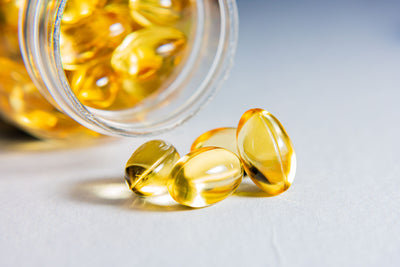
"Perimenopause supplements" and "perimenopause vitamins" are usually treated as one question, and they are two. One is about herbs marketed to relieve symptoms. The other is about nutrients whose requirements genuinely change in midlife, mostly for reasons that have nothing to do with how you feel this week. The second question has much better answers.
The nutrients with a real midlife case
These are not symptom treatments. They are the ones where the requirement, the absorption, or the risk of being short actually shifts at this stage of life.
Calcium and vitamin D — the bone pair
Bone loss accelerates sharply in the late transition and the first years after the final period, running at roughly two percent a year at the spine in that window. That is the fastest bone loss most women will experience, and it happens whether or not you feel anything.
Current US recommendations are 1,000 mg of calcium a day for women aged 19 to 50 and 1,200 mg from 51, with 600 IU (15 mcg) of vitamin D to age 70 and 800 IU (20 mcg) after.
Food first, genuinely: dairy, canned fish with bones, fortified plant milks and leafy greens. Calcium supplements are worth topping up a shortfall, not replacing a diet — and going well above the recommendation is not better, with higher intakes linked to kidney stones. Vitamin D is the harder one to get from food, and supplementing it is more often justified, particularly through winter.
Vitamin B12
Absorption declines with age, and it declines further on long-term metformin or acid-suppressing medication. The requirement is small — 2.4 mcg a day — but a deficiency produces fatigue, poor concentration and low mood, which is to say it produces something indistinguishable from perimenopause. It is worth testing rather than guessing.
Iron — only if you are short
This is the one to get right in both directions. Heavy perimenopausal bleeding is a common cause of iron deficiency, and depleted iron causes fatigue, breathlessness and poor concentration. But iron should not be taken speculatively: excess accumulates and causes harm, and supplementing without testing can mask the investigation of why you were low.
Ask for ferritin alongside a complete blood count — ferritin shows depleted stores before anemia appears, and it is the one most often left off the form.
Magnesium
320 mg a day is the recommendation for women over 30, and intake is commonly below it. The evidence for magnesium as a sleep or anxiety treatment is thinner than the marketing suggests, but as a nutrient it is doing real work across muscle, nerve and bone. Glycinate and citrate are better absorbed and far better tolerated than oxide, which mostly acts as a laxative.
Omega-3
No formal US requirement exists, but 250 to 500 mg a day of combined EPA and DHA is a commonly suggested target, and two portions of oily fish a week gets you there without a capsule. The cardiovascular rationale strengthens after menopause, as the protective effect of estrogen falls away.
Test before you buy
The single most useful thing you can do before spending money on this category is find out what you are actually short of. Four tests cover most of it: ferritin with a complete blood count, vitamin D, B12, and thyroid function. Each can come back with a specific, correctable answer — which is more than can be said for most of the shelf.
We went into this in more detail in what perimenopause blood tests can and cannot tell you.
The other half: supplements sold for symptoms
This is a much weaker evidence base, and it is where most of the money goes. Some things have genuine trial support and genuine interactions — St John's Wort and ashwagandha among them — and we went through those in supplements for mood. For cognitive symptoms specifically, we looked at the evidence in supplements for brain fog.
The general principle holds across both: an ingredient only does what it did in the study if it is present at the dose used in the study, and most products are not.
How to read a label
- Every dose printed. If a product hides amounts inside a "proprietary blend", the doses are below anything meaningful. That is the purpose of the blend.
- Check the form, not just the name. Magnesium oxide and magnesium glycinate are not interchangeable. Nor are folic acid and methylfolate, or cyanocobalamin and methylcobalamin.
- Check the serving size. The front of the bottle quotes the dose per serving; the serving is sometimes four capsules, which quietly quarters the value for money.
- Third-party testing. Supplements are not pre-approved by the FDA for safety or effectiveness before sale. Independent verification is the only thing standing between the label and the contents.
- Fewer ingredients is usually better. Twenty actives on one label means the budget was spread across twenty things.
What to be careful with
- Fat-soluble vitamins — A, D, E and K — accumulate. More is not better and can be harmful.
- High-dose B6 over long periods can cause peripheral nerve damage.
- Calcium well above the recommendation raises kidney-stone risk without buying more bone.
- If you take prescribed medication, check interactions with a pharmacist before adding anything. Supplement does not mean inert.
Where MYNDR sits
We should be plain about our own position here, since we sell in this category. MYNDR is a cognitive support system for daytime focus and night-time recovery. It is not a multivitamin and it is not a bone product — it will not cover your calcium, and it is not intended to. Every dose is printed on the label, which is the standard we would ask you to hold any product in this category to, including ours.
The short version
- Nutrients and symptom supplements are two different questions. The nutrient one has better answers.
- Bone loss accelerates around the final period — calcium 1,200 mg from 51, vitamin D 600 to 800 IU, food first.
- B12 absorption falls with age, and deficiency looks exactly like perimenopause.
- Iron only if tested low. Ask for ferritin, not just a complete blood count.
- Test ferritin, vitamin D, B12 and thyroid before buying anything.
- Undisclosed doses mean low doses. Check the form and the serving size, and prefer third-party tested products.
This article is general information, not medical advice. Talk to a clinician or pharmacist about your own symptoms, history and any supplement taken alongside prescribed medication. These statements have not been evaluated by the Food and Drug Administration. This product is not intended to diagnose, treat, cure or prevent any disease.