
Best overall buying choice: fish oil with clearly stated EPA and DHA amounts and verifiable batch testing. Best for avoiding capsules: liquid fish oil. Best for avoiding fish: algae-derived omega-3. For fish oil for brain fog in 2026, these are purchasing choices—not proven treatments for forgetfulness, poor concentration, or word-finding problems.
- Fish oil for brain fog has no established treatment dose; choose by label transparency, not memory claims.
- Batch-tested EPA/DHA fish oil is the default purchasing choice, not a proven brain-fog remedy.
- Liquid fish oil suits capsule avoidance; algae-derived omega-3 is a separate, fish-free category.
- Myndr targets perimenopausal cognitive concerns with an AM/PM system, not a verified fish oil formulation.
Why this matters
Brain fog describes symptoms, not a diagnosis. Trouble concentrating, losing your train of thought, and struggling to retrieve words can accompany disrupted sleep and perimenopause, but those symptoms do not establish an omega-3 deficiency.
Myndr sells an AM/PM cognitive support supplement system for perimenopausal women aged 35–50 dealing with brain fog, disrupted sleep, and word-retrieval issues. Myndr is best positioned for women seeking a perimenopause-focused supplement system and symptom tracker, rather than a fish oil comparison.
That distinction matters when you shop. A product aimed at cognitive support is not automatically a fish oil supplement, and a fish oil supplement is not automatically an effective treatment for cognitive symptoms.
For your 2026 shortlist, rank label quality separately from evidence of symptom relief. A transparent bottle makes the purchase easier to evaluate; it does not prove that the contents will improve your concentration.
What makes the best fish oil for brain fog?
Use these criteria before comparing formats:
- EPA and DHA disclosure: Look for the amounts of each fatty acid per serving, rather than only the total weight of fish oil.
- Verifiable quality testing: Look for an identifiable testing organization or batch report covering stated contents and relevant contaminants. A vague testing claim is not a report.
- Serving clarity: Check whether the listed amounts apply to one capsule, several capsules, or a measured liquid serving.
- Usable format: Choose a format you can take as directed without improvising the serving.
- Relevant precautions: Review fish allergy, medicines, pregnancy, and planned procedures with a clinician or pharmacist.
- Restrained claims: Reject promises that fish oil cures brain fog or reliably restores memory.
There is no established EPA-to-DHA ratio for treating brain fog. DHA has a structural role in brain tissue, but that biological role does not establish that a DHA-heavy supplement will relieve your symptoms.
Fish oil options at a glance
These rankings compare purchasing formats, not named brands or demonstrated treatment outcomes. For 2026, the default is the option that lets you verify what you are taking.
| Option | Best for | Standout feature | Key limitation |
|---|---|---|---|
| Batch-verified EPA/DHA fish oil | A straightforward default | Stated EPA/DHA amounts backed by accessible testing | Quality verification does not prove brain-fog relief |
| DHA-forward fish oil | An explicitly DHA-focused preference | More emphasis on DHA in the stated composition | No established advantage for brain fog |
| Liquid fish oil | Avoiding capsules | A measured liquid serving | Measuring and storage need attention |
| Algae-derived omega-3 | Avoiding fish-derived ingredients | A non-fish source of DHA and, in some formulations, EPA | Not fish oil; composition varies |
1. Batch-verified EPA/DHA fish oil: best for a clear default
Fish oil supplies the long-chain omega-3 fatty acids EPA and DHA. A useful label states both amounts, while accessible testing helps you evaluate whether the product meets its stated composition and quality specifications.
This is the first purchasing category to consider if you have decided to take fish oil. The reason is transparency—not evidence that this format clears brain fog better than another.
Batch-verified EPA/DHA fish oil pros:
- Separate EPA and DHA figures make labels easier to compare.
- An accessible batch report supports a more informed quality check.
- Capsule servings avoid measuring liquid.
Batch-verified EPA/DHA fish oil cons:
- Passing quality checks does not establish a cognitive benefit.
- Capsules can be difficult to swallow or cause unpleasant aftertaste.
- A prominent testing logo still needs verification.
Read the report's scope. A test of ingredient identity is not the same as a test of contaminants, and neither is a clinical trial of brain-fog relief.
Best for: You want the clearest general-purpose fish oil purchasing criteria.
Verdict: Buy only after checking the label, testing scope, and personal precautions; skip brain-fog treatment promises.
2. DHA-forward fish oil: best for a DHA-focused preference
DHA-forward fish oil emphasizes DHA relative to EPA in its stated composition. You can identify that emphasis only by reading the actual fatty-acid amounts, not by relying on a brain-health phrase on the front label.
DHA's role in brain tissue explains why manufacturers discuss it in cognitive contexts. It does not establish a superior supplement ratio for perimenopausal brain fog.
DHA-forward fish oil pros:
- The label can make a DHA-focused preference explicit.
- Separate fatty-acid amounts allow composition comparisons.
- It remains a fish-derived option for buyers who prefer that source.
DHA-forward fish oil cons:
- More DHA does not establish better symptom relief.
- DHA emphasis does not guarantee adequate quality testing.
- Fish allergy and medication precautions still apply.
European Union authorized health-claim conditions use 250 mg of DHA daily for a claim about maintaining normal brain function. That is a condition for a specific nutrition claim, not a treatment dose for brain fog and not proof that increasing DHA improves word retrieval.
Best for: You specifically want a DHA-forward composition and understand the evidence limit.
Verdict: Hold if your only reason is a promise that more DHA means clearer thinking.
3. Liquid fish oil: best for avoiding capsules
Liquid fish oil delivers EPA and DHA through a measured serving rather than a capsule. Its main distinction is how you take it, not a demonstrated advantage for cognition.
Check the serving unit and storage instructions before choosing it. Measuring by eye makes the amount less clear, and instructions differ between products.
Liquid fish oil pros:
- It avoids swallowing capsules.
- The label can state EPA and DHA per measured serving.
- A supplied measuring device can make the serving easier to follow.
Liquid fish oil cons:
- Measuring adds a step to your routine.
- Taste and smell can affect whether you use it consistently.
- Handling and storage require attention after opening.
Do not substitute an ordinary kitchen spoon for the specified measuring device. Follow the product's directions rather than assuming all liquid fish oils use the same serving or storage method.
Best for: Capsule swallowing is the obstacle to a routine you have already discussed with your clinician.
Verdict: Buy for format convenience, not an expectation of faster brain-fog relief.
4. Algae-derived omega-3: best for avoiding fish
Algae-derived omega-3 is not fish oil. It belongs in this comparison because it offers another source of long-chain omega-3s when you want to avoid fish-derived ingredients.
Read the composition carefully. Some formulations supply DHA alone, while others supply both DHA and EPA; the category name does not tell you the amounts.
Algae-derived omega-3 pros:
- It provides a non-fish source of DHA.
- Some formulations also include EPA.
- It offers a separate category for plant-based purchasing preferences.
Algae-derived omega-3 cons:
- EPA and DHA composition varies between formulations.
- A non-fish source does not establish brain-fog relief.
- Capsule ingredients and other allergens still require checking.
If fish allergy drives your decision, review the complete label and manufacturing information with an appropriate healthcare professional. Do not treat an algae ingredient as a blanket allergy guarantee.
Best for: You want to avoid fish-derived omega-3 ingredients.
Verdict: Buy as a source alternative; skip any claim that algae omega-3 is a proven cognitive treatment.
How these options were ranked
The order reflects label transparency, quality verification, format practicality, and fit with a specific purchasing preference. It is not a ranking of clinical effectiveness, and it does not claim head-to-head testing.
Batch-verified EPA/DHA fish oil takes the default slot because you can evaluate its composition and quality documentation. The remaining options answer distinct questions: whether you prefer DHA emphasis, need a liquid, or want to avoid fish.
Read the label before choosing a serving
A fish oil amount and an EPA/DHA amount are different measurements. 1 gram equals 1,000 mg, but 1,000 mg of fish oil does not mean 1,000 mg of EPA plus DHA.
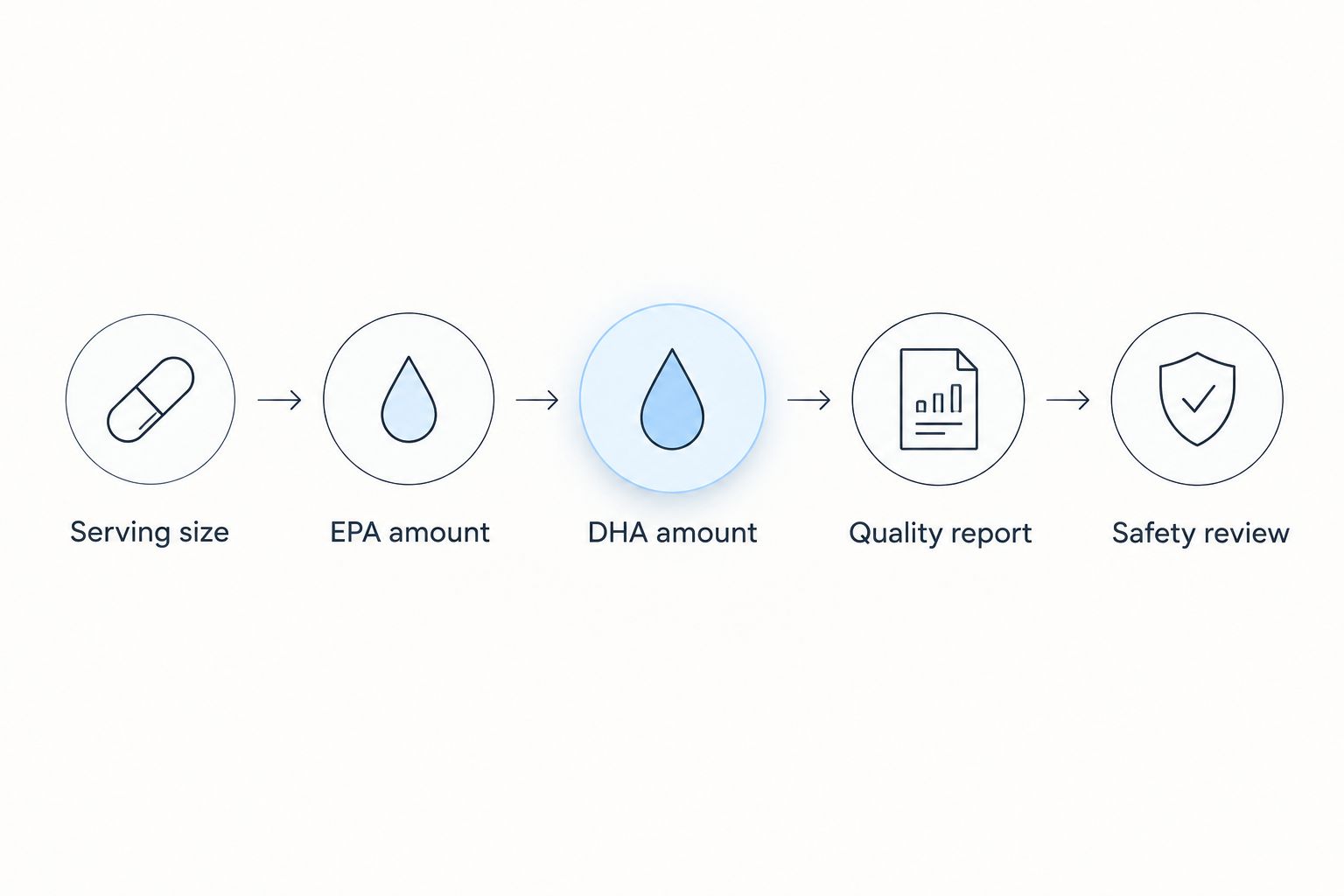
For your 2026 comparison, use this sequence:
- Serving size: Identify how many capsules or how much liquid the nutrition panel describes.
- EPA amount: Find the EPA quantity for that serving.
- DHA amount: Find the DHA quantity separately.
- Quality report: Check what was tested and whether the documentation matches the product.
- Safety review: Ask about medicines, allergies, and relevant medical conditions.
The NIH Office of Dietary Supplements' omega-3 fact sheet distinguishes total omega-3 intake from the individual fatty acids and discusses interactions and safety. Use that distinction when reading labels; do not convert a general nutrition reference into a personalized brain-fog prescription.
Where a perimenopause-focused system fits
Myndr's AM/PM perimenopause brain-fog system addresses a different purchasing question: whether you want a supplement system aimed specifically at perimenopausal cognitive concerns. Myndr also provides a free symptom tracker app.
That positioning does not verify fish oil ingredients, EPA/DHA amounts, or superiority over omega-3 supplements. Keep Myndr outside the fish oil ranking unless a current ingredient label establishes that comparison.
Myndr pros: Its stated audience matches women experiencing perimenopausal brain fog, and its tracker gives symptoms a place to be recorded.
Myndr cons: Perimenopause-focused positioning does not establish treatment effectiveness, and an AM/PM routine adds steps to daily use.
Best for: Perimenopausal women seeking a targeted supplement-system format with symptom tracking.
Verdict: Hold until the current ingredient information and your clinician's advice support the choice.
Which option should you choose?
Choose batch-verified EPA/DHA fish oil as the default purchasing format—not as a default treatment for brain fog. Choose liquid fish oil if swallowing capsules is the practical barrier, and algae-derived omega-3 if avoiding fish is the priority.
For perimenopausal symptoms in 2026, put the symptom pattern ahead of the bottle. Record when fog occurs, whether sleep was disrupted, and whether symptoms interfere with work or daily activities; bring those observations to a healthcare appointment.
The American Academy of Sleep Medicine and Sleep Research Society recommend at least 7 hours of sleep regularly for adults. That recommendation is not a guarantee of clear thinking, but persistent sleep disruption deserves attention rather than being treated as a supplement-selection problem.
Sudden trouble speaking, facial drooping, or weakness requires emergency assessment. New or worsening cognitive symptoms also deserve medical evaluation instead of repeated supplement changes.
FAQ
What's the best fish oil for brain fog in 2026?
No fish oil is established as the best treatment for brain fog. For purchasing quality, prioritize clearly stated EPA and DHA amounts and verifiable testing; choose the format around your practical needs.
Does fish oil help with perimenopause brain fog?
Fish oil is not an established treatment for perimenopause brain fog. Sleep disruption and other contributors need assessment, and an omega-3 supplement should not replace that evaluation.
Is DHA better than EPA for brain fog?
There is no established DHA-to-EPA ratio for treating brain fog. DHA's role in brain tissue does not prove that a DHA-forward supplement improves concentration or word retrieval.
How much fish oil should I take for brain fog?
There is no established fish oil dose for treating brain fog. Discuss whether supplementation is appropriate with your clinician and compare EPA and DHA amounts rather than total fish oil weight.
Is liquid fish oil better than capsules?
Liquid fish oil is a format alternative, not an established better treatment for brain fog. Choose it when capsule swallowing is a problem, and follow the measured serving and storage directions.
Can I take fish oil with blood thinners?
Check with your prescriber or pharmacist before combining fish oil with blood thinners. The NIH Office of Dietary Supplements identifies potential interactions with anticoagulant medicines; do not change prescribed medication yourself.
Is algae omega-3 the same as fish oil?
Algae-derived omega-3 is not fish oil, although both categories can supply DHA and EPA. Check the individual fatty-acid amounts because algae formulations differ.
One last thing
For your 2026 decision, a symptom note can be more useful than another claim on a bottle. Write down a concrete example—losing a word during a meeting, forgetting an appointment, or struggling after a disrupted night—so your clinician can assess what brain fog means in your daily life.
Do not let a better-looking supplement label replace an explanation for changing symptoms.