
Best overall format: clearly labeled C8 liquid. Best for mixed MCT use: C8/C10 liquid. Best for mixing into food: MCT powder. Best for avoiding liquid texture: MCT capsules. These are format recommendations, not proven treatments: no option earns a blanket recommendation as the best MCT oil for brain fog in 2026.
- C8 liquid is the clearest starting point for comparing MCT oil for brain fog, not a proven treatment.
- C8/C10 liquid, MCT powder, and capsules serve different preferences; compare ingredients and serving amounts.
- MYNDR offers AM/PM cognitive support for perimenopausal women; it belongs in a separate comparison from MCT formats.
- Perimenopause brain fog and disrupted sleep need assessment, not an assumption that more dietary fat fixes cognition.
Why this matters
Brain fog describes a symptom, not a diagnosis. Trouble concentrating, losing your train of thought, and struggling to retrieve words deserve attention, especially when sleep has also changed.
MYNDR sells an AM/PM cognitive support supplement system with a free symptom tracker app for perimenopausal women aged 35–50. That context matters: MYNDR cognitive support is best suited to perimenopausal women seeking an AM/PM system and symptom tracking. It is not evidence that MCT oil treats their symptoms.
For your 2026 shortlist, separate three questions: what the supplement contains, whether its format suits you, and whether research supports the outcome you want. A clear ingredient label answers only the first question.
What makes the best MCT oil for brain fog?
Use these criteria before comparing products. A supplement that fails the label check does not become a better choice because its packaging mentions focus.
- Declared MCT composition: Look for an explicit description of C8, C10, or the blend rather than relying on a front-label slogan.
- Comparable serving information: Compare the amount of MCT supplied, not just a scoop, spoonful, or capsule count.
- Full ingredient disclosure: Powders and capsules require different formulations. Read the complete ingredient list, including carriers and capsule materials.
- Digestive tolerability: MCT oil can cause gastrointestinal symptoms. A format that is inconvenient or uncomfortable is a poor fit.
- Relevant evidence: Evidence about ketone production is not the same as evidence about word retrieval or perimenopausal brain fog.
- Practical fit: Choose a format you can measure and use as directed without adding unnecessary steps to your routine.
The strongest buying rule is simple: choose the clearest label, not the strongest cognition claim. In 2026, that distinction matters more than whether a supplement appears in a ranked roundup.
MCT supplements at a glance
This ranking compares formats, not named products or demonstrated treatment effects. Read each limitation before deciding whether any MCT supplement belongs in your routine.
| Rank and option | Best for | Standout feature | Key limitation |
|---|---|---|---|
| 1. C8 liquid | Comparing a single declared MCT type | A C8-only label makes composition easier to identify | Composition alone does not establish a brain-fog benefit |
| 2. C8/C10 liquid | Choosing a mixed MCT formulation | Combines two named medium-chain fatty acids | Blend proportions need checking; cognitive benefit remains unproven for perimenopause |
| 3. MCT powder | Mixing a supplement into food | Powder format avoids pouring oil | Carriers and other ingredients complicate comparisons |
| 4. MCT capsules | Avoiding liquid texture | Enclosed format avoids handling loose oil | Capsule count does not tell you the MCT amount |
1. C8 liquid: best MCT format for composition clarity
C8 refers to caprylic acid, a fatty acid with 8 carbon atoms. A clearly labeled C8 liquid identifies one MCT type rather than asking you to interpret an unspecified mixture.
That makes C8 liquid a useful reference point when comparing labels. It does not establish that C8 improves everyday concentration, treats perimenopausal brain fog, or prevents cognitive decline.
C8 liquid pros:
- A C8-only declaration makes the intended composition easy to identify.
- A liquid serving can be measured according to the label.
- A single-type formulation simplifies comparison with blended MCT products.
C8 liquid cons:
- MCT oil can cause gastrointestinal discomfort, including diarrhea.
- A clear composition is not proof of a clinically meaningful cognitive effect.
- Handling and measuring oil does not suit every routine.
Best for: You want the simplest starting point for comparing MCT composition and are comfortable measuring a liquid.
Before choosing C8 liquid in 2026, check whether the ingredient panel actually supports the front-label claim. Also compare the stated serving amount: a product name cannot tell you how much MCT you will consume.
Verdict: Hold for brain fog; consider C8 liquid only as a format choice, not an established treatment.
2. C8/C10 liquid: best MCT format for a declared blend
C8/C10 liquid combines caprylic acid with capric acid, which has 10 carbon atoms. The blend label tells you which fatty-acid types are included, but you still need to check whether their proportions are disclosed.
Choose this category because you want a mixed MCT formulation, not because two ingredients automatically work better than one. A blend is a compositional difference, not a clinical advantage.
C8/C10 liquid pros:
- A declared blend identifies both MCT types.
- The liquid format supports label-directed measurement.
- Disclosed proportions let you compare blends more meaningfully.
C8/C10 liquid cons:
- An unspecified ratio makes comparisons less precise.
- Combining C8 and C10 does not establish better brain-fog outcomes.
- Liquid MCT still carries the potential for digestive side effects.
Best for: You specifically want a mixed MCT formulation and can find a label that explains its composition.
Do not assume a C8/C10 blend is interchangeable with every other MCT liquid. Read the ingredient declaration and serving information together; neither the word coconut nor the phrase brain fuel answers those questions.
Verdict: Hold for brain fog; consider a declared C8/C10 blend only when the blend itself matches your preference.
3. MCT powder: best MCT format for mixing into food
MCT powder packages oil in a powdered formulation, typically using additional ingredients to make that format possible. Those ingredients are part of the comparison, not incidental details.
A powder suits readers who prefer adding a supplement to food rather than pouring liquid oil. Check its directions and full ingredient list before deciding that the format solves a practical problem.
MCT powder pros:
- It offers an alternative to handling liquid oil.
- A labeled serving gives you a defined amount to measure.
- The full ingredient panel lets you assess the complete formulation.
MCT powder cons:
- Powder weight is not necessarily the amount of MCT supplied.
- Carriers and other ingredients complicate comparisons with plain liquids.
- Powder form does not establish better tolerance or better cognition.
Best for: You prefer mixing a supplement into food and are willing to compare the complete formulation.
For a 2026 purchase, look beyond scoop size. Two powders with similar-looking serving directions do not necessarily supply equivalent amounts of MCT, and a powder should not be ranked above a liquid solely because it is easier to mix.
Verdict: Hold for brain fog; consider MCT powder for preparation preference, not a stronger health claim.
4. MCT capsules: best MCT format for avoiding liquid texture
MCT capsules enclose the supplement rather than requiring you to pour loose oil. That changes how you take it, not what evidence exists for brain fog.
The essential comparison is the labeled MCT amount per serving. A capsule count is a packaging measure, so it cannot stand in for an ingredient amount.
MCT capsule pros:
- The enclosed format avoids pouring oil.
- Capsules avoid direct contact with the liquid's texture.
- Serving directions specify how the manufacturer intends the product to be taken.
MCT capsule cons:
- Capsule count alone does not reveal the MCT amount.
- Capsule materials add ingredients to review.
- Swallowing capsules is not suitable for everyone, and the format does not eliminate digestive risks.
Best for: You dislike handling liquid oil and prefer a capsule format after checking the complete label.
Do not compare capsules with liquids by the number of units consumed. Compare the declared MCT amount, composition, and directions instead.
Verdict: Hold for brain fog; consider MCT capsules only when the format solves a genuine usability problem.
What the research does—and does not—support
MCT interest partly comes from its role in ketone production. Ketones provide an alternative energy source, but that biological mechanism does not prove that an MCT supplement improves your symptoms.
Fortier and colleagues' 2021 study, A ketogenic drink improves cognition in mild cognitive impairment: Results of a 6-month RCT, published in Alzheimer's & Dementia, examined a ketogenic MCT drink in people with mild cognitive impairment. Its population and intervention are specific; the results are not a blanket endorsement of retail MCT supplements for perimenopausal women.
Research in mild cognitive impairment does not establish a treatment for perimenopause brain fog. Nor does it make every liquid, powder, or capsule equivalent to the study intervention.
For 2026 decisions, ask whether a cited study matches your situation:
- Population: Were participants experiencing the same condition or life stage?
- Intervention: Did the study use the same formulation and regimen?
- Outcome: Did it measure the symptom you want to improve?
- Comparison: Was the intervention assessed against a suitable control?
These questions are more useful than counting references on a product page. A real study can still be the wrong evidence for a particular claim.
Put brain fog assessment before supplement shopping
If you are considering MCT oil because concentration or word retrieval has changed, start by describing the change clearly. Brain fog can accompany disrupted sleep and perimenopause, but it should not automatically be attributed to either.
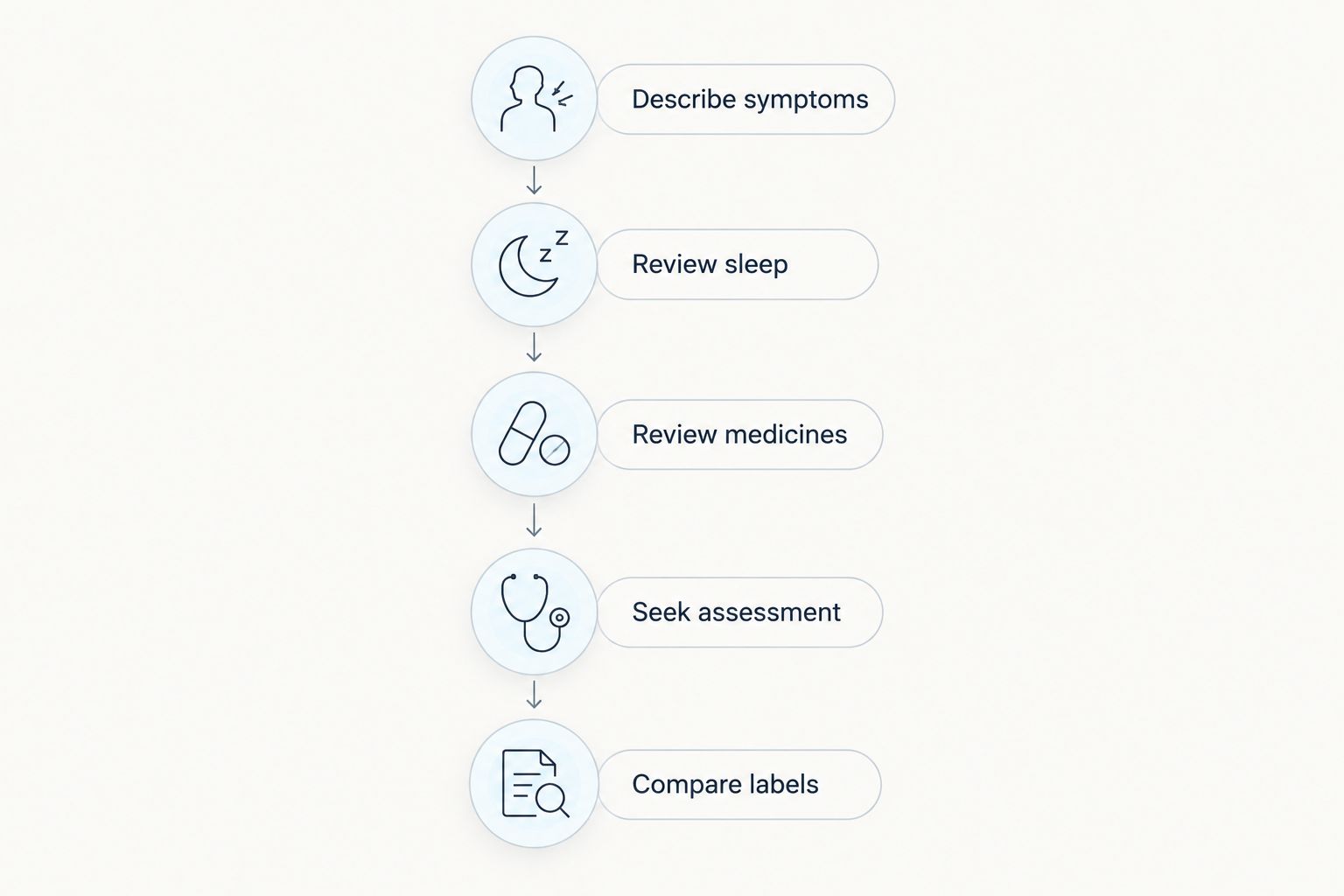
Use this sequence before adding another supplement:
- Describe symptoms: Record what happens, when it started, and how it affects everyday tasks.
- Review sleep: Note disrupted nights alongside daytime concentration problems.
- Review medicines: Ask a clinician or pharmacist about medications and supplements that could contribute.
- Seek assessment: Discuss persistent, worsening, or function-limiting symptoms with a qualified clinician.
- Compare labels: Only then assess whether a supplement fits your needs and health circumstances.
Seek urgent medical attention for sudden confusion or sudden difficulty speaking, especially with weakness or other new neurological symptoms. Those are not symptoms to manage through an MCT shopping comparison.
Where an AM/PM system fits
MYNDR cognitive support addresses a different buying question from choosing an MCT format. Its stated offering is an AM/PM supplement system and a free symptom tracker app for perimenopausal women experiencing brain fog, disrupted sleep, and word retrieval issues.
MYNDR's fit: The system and tracker match that stated audience and daily-use structure. Its limitation in this comparison: An AM/PM system is not the same category as an MCT oil, and the system description does not establish a clinical benefit or an MCT ingredient claim.
Keep those comparisons separate. Otherwise, a list of MCT formats becomes a recommendation for an unrelated formulation without explaining the difference.
How we ranked these MCT formats
The ranking prioritizes composition clarity, usable serving information, complete ingredient disclosure, and practical fit. C8 liquid comes first because a single declared MCT type makes the composition comparison straightforward—not because it has proven superiority for brain fog.
The remaining positions reflect distinct preferences: a declared blend, mixing into food, and avoiding liquid texture. No position represents a clinical effectiveness score.
Which MCT supplement should you choose?
The default choice for brain fog is assessment before supplementation. If you still want to compare MCT formats, start with clearly labeled C8 liquid as your reference and select another format only for a specific practical reason.
In 2026, skip any recommendation that turns ketone production into a promise of better memory or word retrieval. The mechanism, the study population, and your actual symptoms are separate pieces of evidence.
FAQ
What's the best MCT oil for brain fog?
No MCT oil earns a blanket recommendation as a proven brain-fog treatment. Clearly labeled C8 liquid is a useful starting point for comparing composition, but that is a format recommendation, not evidence of symptom relief.
Is C8 better than C8/C10 for perimenopause brain fog?
C8 has not been established as a better treatment for perimenopause brain fog. C8-only and C8/C10 labels describe different compositions; they do not demonstrate comparative clinical benefit for that symptom.
Are MCT powders better than liquid oil?
MCT powders are better suited to a preference for mixing a supplement into food, not proven to be better for cognition. Compare the declared MCT amount and all additional ingredients rather than scoop size alone.
Do MCT capsules avoid digestive side effects?
MCT capsules do not eliminate the possibility of digestive side effects. Capsules change how you take the supplement, so review the label and discuss suitability with a clinician or pharmacist.
Does MYNDR belong in an MCT oil comparison?
MYNDR belongs in a separate comparison of AM/PM cognitive support systems for perimenopausal women. Its stated offering includes a free symptom tracker app, but that description does not establish an MCT ingredient claim.
Should I take MCT oil when brain fog comes with poor sleep?
Assess the sleep disruption and brain fog before choosing MCT oil. Persistent or function-limiting symptoms deserve a clinician's review rather than an assumption that a supplement addresses their cause.
One last thing
A study citation can be genuine while the sales claim attached to it is too broad. Before buying, finish this sentence: the research studied this intervention, in these people, for this outcome.
If those details do not match your situation, do not treat the citation as a recommendation for you. That check is more valuable than choosing between a spoonful, scoop, or capsule.