Best overall: symptom-led care, not a default herb. Best herbal option to discuss for hot flashes: soy isoflavones. Best choice when interactions are unresolved: skip the purchase. This 2026 guide ranks perimenopause herbal supplements by their evidence, symptom fit, and safety—not by promises to balance hormones.
- Perimenopause herbal supplements are not a first-line treatment for hot flashes; soy isoflavones have limited, inconsistent benefits.
- Black cohosh, valerian, and ashwagandha need different safety checks; none is an established treatment for perimenopause brain fog.
- Myndr offers AM/PM cognitive support for women with perimenopause brain fog, disrupted sleep, and word retrieval issues.
- Choose one target symptom, review medications, and avoid starting several supplements together.
Why this matters
Hot flashes, poor sleep, and trouble finding words are different treatment targets. A supplement studied for one does not automatically help the others, and a blend marketed for menopause does not establish that every ingredient works.
Myndr is best for women exploring an AM/PM cognitive-support system aimed at perimenopause brain fog and disrupted sleep. That describes the product's intended audience, not proof of effectiveness. You can review Myndr's AM/PM perimenopause cognitive-support formula separately from the botanical options below.
For a 2026 buying decision, start with the symptom disrupting your life. The Menopause Society does not recommend supplements or herbal remedies for treating vasomotor symptoms, which include hot flashes and night sweats. That recommendation concerns symptom treatment; it does not mean every botanical has identical evidence or risks.
What makes the best perimenopause herbal supplements
Use these criteria before comparing labels:
- Symptom fit: Research on hot flashes does not establish benefits for memory, sleep, or mood.
- Human evidence: Prefer studies in people with the relevant symptoms over laboratory findings or testimonials.
- Ingredient clarity: Look for the botanical identity, preparation, and amount rather than an unexplained blend.
- Interaction safety: Check prescriptions, other supplements, pregnancy possibility, and relevant medical conditions.
- Manufacturing checks: Independent quality verification helps assess contents; it does not prove symptom relief.
- A review plan: Decide what you will track and what would make you stop before taking the first dose.
In 2026, a supplement label still cannot tell you whether your symptoms come from perimenopause, another condition, or medication effects. That distinction belongs in a clinical assessment, particularly when symptoms are new, persistent, or worsening.
Perimenopause herbal supplements at a glance
The order below is a screening order, not a proven efficacy leaderboard. Each option has a distinct role, and none earns an unconditional buy recommendation.
| Option | Best for | Standout consideration | Key limitation |
|---|---|---|---|
| Soy isoflavones | Discussing a targeted hot-flash option | Some research suggests a small reduction in hot flashes | Results vary; concentrated supplements differ from soy foods |
| Black cohosh | Checking a commonly marketed menopause herb | Directly marketed and studied for menopausal symptoms | Inconsistent evidence and reports of liver injury |
| Valerian | Evaluating a sleep-focused herb | Studied for sleep rather than hormone replacement | Sleep evidence is inconsistent; sedation needs attention |
| Ashwagandha | Separating stress claims from menopause claims | Some preparations have been studied for stress and sleep | Not an established perimenopause treatment; thyroid and liver cautions |
| St. John's wort | Identifying mood-related interaction risks | Evidence concerns depression, not general menopause support | Numerous clinically important drug interactions |
1. Soy isoflavones: best for a targeted hot-flash discussion
Soy isoflavones are plant compounds with estrogen-like activity. The National Center for Complementary and Integrative Health, or NCCIH, describes evidence suggesting that soy isoflavones can reduce hot flashes, but the effect is small and results are inconsistent.
That makes soy a discussion option, not a dependable answer. Research on hot flashes also does not establish that a soy supplement improves word retrieval, concentration, or every symptom associated with perimenopause.
Soy isoflavones pros:
- Have human research directly relevant to hot flashes.
- Offer a clearly defined symptom target for a treatment discussion.
- Allow you to distinguish a specific ingredient from a broad menopause blend.
Soy isoflavones cons:
- Benefits are limited and inconsistent across studies.
- Concentrated supplements are not interchangeable with ordinary soy foods.
- Soy allergy and a history of hormone-sensitive disease require attention before use.
Best for: Someone whose main concern is hot flashes and who wants to discuss the evidence with a clinician.
Ask whether a concentrated preparation fits your medical history. Do not assume that eating tofu and taking a concentrated extract carry identical considerations, or that more isoflavones produce better results.
Verdict: Hold until you have a symptom-specific plan and a safety review.
2. Black cohosh: best for scrutinizing a menopause-specific claim
Black cohosh is an herb commonly marketed for menopausal symptoms. NCCIH describes mixed findings, with important differences between the preparations studied.
The name on the front of a bottle is therefore not enough. Evidence for one preparation does not establish that an unrelated blend or extract will deliver the same result.
Black cohosh pros:
- Has been studied specifically for menopausal symptoms.
- Has an identifiable botanical ingredient you can review with a pharmacist.
- Has published safety information that helps inform a purchasing decision.
Black cohosh cons:
- Evidence does not support a dependable hot-flash benefit across products.
- Liver injury has been reported in people taking products labeled as black cohosh, although causation is uncertain.
- Some commercial products have contained incorrect or undisclosed herbs.
Best for: Someone already considering black cohosh who needs to examine the preparation and safety concerns—not someone seeking a default recommendation.
If you have liver disease, do not self-select black cohosh. Stop taking it and seek medical advice if you develop signs such as dark urine or yellowing of the skin or eyes.
Verdict: Wait for a clinician or pharmacist review rather than buying on the menopause label alone.
3. Valerian: best for evaluating a sleep-specific option
Valerian is used as a sleep aid, but NCCIH describes inconsistent evidence for sleep problems. It is not an established treatment for perimenopause itself, and improving sleep is a different claim from correcting hormonal changes.
First identify what wakes you. Night sweats, insomnia, and possible sleep apnea call for different assessments; a sedating herb does not resolve that distinction.
Valerian pros:
- Has a specific sleep-related purpose rather than an all-symptom claim.
- Has been investigated in human sleep studies.
- Can be assessed separately from other ingredients in a nighttime blend.
Valerian cons:
- Research does not establish reliable sleep benefits.
- Combining it with alcohol or sedating medicines raises safety concerns.
- Long-term safety information is limited.
Best for: Someone evaluating a sleep-focused herb after checking medications and the likely cause of disrupted sleep.
Do not use valerian to push through unexplained daytime sleepiness. If you snore heavily, wake gasping, or feel persistently unrefreshed, discuss those symptoms with a clinician instead of adding another nighttime product.
Verdict: Hold while you address the cause of poor sleep and review sedating substances.
4. Ashwagandha: best for separating stress support from menopause treatment
Ashwagandha appears in products marketed for stress and sleep. NCCIH reports that some preparations have evidence for those uses, but that does not establish a benefit for perimenopause hot flashes, brain fog, or word retrieval.
The distinction matters. A stress-related study cannot substantiate a claim that an ingredient restores estrogen levels or treats the full perimenopause symptom pattern.
Ashwagandha pros:
- Has human research involving some stress and sleep outcomes.
- Gives you a specific ingredient to evaluate rather than an undefined wellness claim.
- Has documented safety cautions you can check before use.
Ashwagandha cons:
- Is not an established treatment for perimenopause symptoms.
- Has been linked to rare liver injury and can affect thyroid function.
- Is unsuitable during pregnancy and needs review with several medicines and medical conditions.
Best for: Someone investigating stress-related claims who understands that these are not menopause-treatment claims.
Pregnancy remains possible during perimenopause. If you have thyroid disease, an autoimmune condition, or take medicines affecting these conditions, get individualized advice before considering ashwagandha.
Verdict: Wait for a safety review; skip it as a presumed hormone-balancing solution.
5. St. John's wort: best for spotting a mood-related safety problem
St. John's wort has research involving depression, but it is not a general-purpose perimenopause supplement. Mood symptoms deserve assessment rather than an assumption that an herb marketed for emotional balance is the right treatment.
Its interaction profile is the decisive issue. NCCIH warns that St. John's wort interacts with many medicines, including antidepressants and hormonal contraceptives.
St. John's wort pros:
- Has human evidence concerning a defined mental-health condition.
- Has well-described interaction information.
- Allows a clear distinction between depression research and broad menopause marketing.
St. John's wort cons:
- Can reduce the effectiveness of several medicines, including hormonal contraception.
- Can cause serious serotonin-related effects when combined with certain antidepressants.
- Does not establish benefits for perimenopause brain fog or disrupted sleep.
Best for: A medication-review conversation when you are considering an herb for persistent mood symptoms.
Do not replace a prescribed antidepressant or combine treatments on your own. Seek prompt mental-health support for severe symptoms, and urgent help for thoughts of self-harm.
Verdict: Skip self-directed use, especially if you take prescription medicines.
How to make a decision without stacking supplements
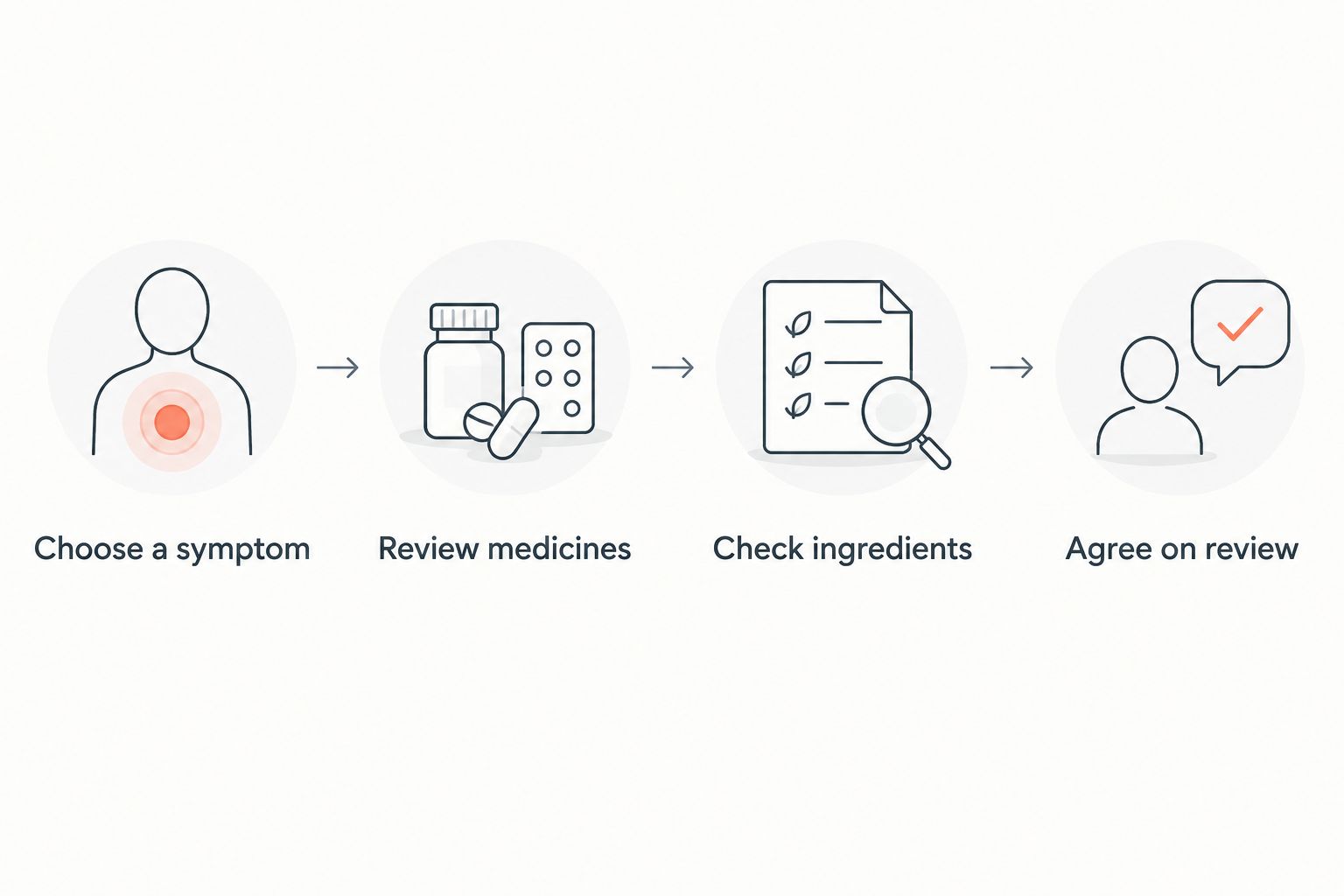
A useful 2026 plan starts with observation, not a collection of bottles. Make the decision in this order:
- Choose a symptom. Track 1 primary symptom daily, such as nighttime waking or word-finding difficulty.
- Review medicines. Include prescriptions, nonprescription sleep aids, alcohol use, and existing supplements.
- Check ingredients. Identify every active ingredient and avoid overlapping products.
- Agree on review. Decide with your clinician what improvement would matter and which adverse effects require stopping.
Bring 7 days of notes to make the conversation concrete. That is a suggested preparation step, not a validated test or a promise that a supplement works within that period.
Introduce no more than 1 new supplement at a time if your clinician agrees to a trial. Changing several products together makes it harder to identify what helped or what caused a problem. Do not wait for a tracking period to end before reporting an adverse reaction.
Where Myndr fits—and where the evidence stops
Myndr sells an AM/PM cognitive-support supplement system for women aged 35–50 experiencing perimenopause brain fog, disrupted sleep, and word retrieval issues. It also offers a free symptom tracker app.
Myndr pros:
- Its stated focus matches those cognitive and sleep-related concerns.
- The AM/PM format provides a defined structure to discuss.
- Its symptom tracker app offers a way to record your experience.
Myndr cons:
- Intended use does not establish clinical effectiveness.
- An AM/PM format alone does not establish an advantage over other approaches.
- It should not be classified as an herbal option without checking the ingredients.
Best for: Women comparing cognitive-support approaches, rather than seeking a proven herbal treatment for hot flashes.
For 2026, keep the product decision separate from diagnosis. A symptom tracker can organize observations, but it cannot determine whether perimenopause is the cause or whether a supplement is safe with your medicines. Verdict: Hold until you review the ingredient label and your treatment needs.
How we ranked these options
This guide prioritizes symptom-specific human evidence, identifiable ingredients, and safety information. The evidence summaries draw on NCCIH's resources on menopause symptoms, soy, black cohosh, valerian, ashwagandha, and St. John's wort; the hot-flash treatment standard comes from the Menopause Society's nonhormone therapy position statement.
The ranking does not claim head-to-head superiority. Soy comes first because its evidence directly addresses hot flashes, while the other entries answer different questions about menopause marketing, sleep, stress, and mood-related interactions.
Which option should you choose?
If you are undecided, choose assessment before supplementation. For disruptive hot flashes, ask about established hormonal and nonhormonal treatments rather than assuming an herb is the gentler or safer route.
For sleep problems, identify what interrupts sleep. For brain fog or word retrieval issues, discuss the symptom pattern and other possible contributors with a clinician. A menopause label is not a diagnosis, and new or worsening cognitive symptoms deserve attention.
If you still want to explore an herb, soy isoflavones are the first targeted discussion in this list—not a blanket recommendation to buy. The practical winner is the option that fits your symptom and clears the safety review.
FAQ
What's the best herbal supplement for perimenopause?
There is no single best herbal supplement for perimenopause. Soy isoflavones have limited, inconsistent evidence for hot flashes, but they are not a proven answer for brain fog, sleep disruption, and every other symptom.
Do perimenopause herbal supplements balance hormones?
A hormone-balancing claim does not establish that a supplement treats perimenopause. Ask what specific symptom was studied, which preparation was used, and whether the findings apply to the product you are considering.
Is black cohosh better than soy for hot flashes?
The evidence does not establish that black cohosh is better than soy for hot flashes. Soy has evidence of small, inconsistent benefits, while black cohosh findings vary by preparation and require attention to liver-related safety reports.
Can valerian help me sleep during perimenopause?
Valerian is not a reliably established treatment for sleep problems. Review sedating medicines and alcohol use, and investigate whether night sweats, insomnia, or another sleep condition is causing the disruption.
Is ashwagandha safe during perimenopause?
Ashwagandha is not suitable for everyone during perimenopause. Pregnancy possibility, thyroid conditions, autoimmune conditions, liver concerns, and medication interactions require a safety review before use.
Can I take herbal supplements with antidepressants or birth control?
Do not assume herbal supplements are compatible with antidepressants or hormonal contraception. St. John's wort has particularly important interactions, so ask a pharmacist to review the exact ingredients and medicines.
Is Myndr an herbal treatment for perimenopause brain fog?
Myndr is described as an AM/PM cognitive-support supplement system, not an established herbal treatment. Check the ingredient label before classifying it as herbal, and distinguish its intended use from evidence of effectiveness.
One last thing
A quality seal answers a contents question, not an effectiveness question. Independent verification can help assess whether a supplement contains what its label states, but it cannot prove that the supplement relieves your symptoms.
Make that your final check in 2026: first ask whether the approach has evidence for your specific problem, then whether the product is appropriate and accurately labeled. Reversing those questions turns careful shopping into a substitute for treatment.